

Blockchain technology is more than just the engine behind Bitcoin—it’s a secure, transparent way to record and share information across a network. Instead of relying on a single authority, blockchain stores data in linked blocks that are nearly impossible to alter, making it ideal for everything from payments to supply chains.
But how does it actually work? In this guide, we’ll break down what blockchain is, explain the core concepts in plain English, and show you why it matters. By the end, you’ll understand the basics well enough to follow the conversation—and spot where this technology could impact your own life or business.
Introduction
Blockchain technology has moved from the margins of computer science into everyday conversations about money, contracts, supply chains, and digital identity. Yet for many people, the term remains fuzzy — a buzzword attached to cryptocurrency headlines rather than a concrete tool they can understand. This article explores What Is Blockchain Technology and How Does It Work with clear, practical guidance, so you can separate the genuine capabilities from the hype.
At its core, a blockchain is a shared record of transactions that many independent computers maintain together. Instead of one company or government keeping the authoritative ledger, copies exist across a network, and rules built into the software decide which new entries get added. That design produces a system where records are difficult to alter secretly and easy to verify publicly. Understanding the fundamentals of What Is Blockchain Technology and How Does It Work helps you make informed decisions — whether you are evaluating an investment, considering a career move, or simply trying to follow the news.
Reliable information and consistent habits lead to better long-term outcomes, and that principle applies here as much as anywhere. Approaching blockchain with curiosity, a willingness to test small examples, and a healthy skepticism toward get-rich-quick claims will serve you far better than chasing every new token or platform.
Key Concepts
Before diving into mechanics, it helps to lock down the vocabulary. These terms appear constantly in blockchain discussions, and misunderstanding them is the fastest route to confusion.
- Block: A bundle of transaction data, plus a timestamp and a cryptographic reference to the previous block.
- Chain: The sequence formed when each block links to the one before it, creating a tamper-evident history.
- Node: A computer running the blockchain software that stores a copy of the ledger and helps validate new entries.
- Consensus mechanism: The rules nodes follow to agree on which block comes next. Common examples include proof of work and proof of stake.
- Public key and private key: A cryptographic pair. The public key works like an account number; the private key works like a password you must never share.
- Smart contract: Code stored on the blockchain that executes automatically when predefined conditions are met.
- Immutability: The property that once a block is buried under enough later blocks, changing it becomes computationally impractical.
Two distinctions matter early. First, blockchain is not the same as Bitcoin. Bitcoin was the first major application of blockchain, but the technology now supports many uses beyond currency. Second, “public” and “private” blockchains serve different purposes: public chains are open to anyone, while private or permissioned chains restrict who can read and write.
Deep Dive
So how does a blockchain actually work in practice? Picture a group of strangers who want to keep a shared accounting book without trusting a central bookkeeper. Every ten minutes or so, participants broadcast new transactions to the network. Nodes collect these into a candidate block and then compete or cooperate — depending on the consensus rules — to decide whose block becomes official.
Under proof of work, nodes called miners race to solve a mathematical puzzle. The winner earns the right to append the block and receives a reward. Under proof of stake, validators are chosen based on the amount of cryptocurrency they have locked up as collateral, which aligns their incentives with honest behavior. Either way, once a block is accepted, every node updates its copy, and the chain grows.
Why is this hard to cheat? Changing an old transaction would change that block’s cryptographic fingerprint, which would invalidate every block after it. An attacker would need to redo all that work faster than the rest of the network combined — an economically irrational proposition on large networks. This is the security model in one sentence: honesty is cheaper than cheating.
The same architecture supports uses far beyond payments. Supply chains use blockchains to trace goods from farm to shelf. Artists use them to prove ownership of digital work. Developers build decentralized applications on platforms like Ethereum, where smart contracts handle everything from loans to voting. Each use case trades some decentralization for speed, privacy, or regulatory compliance, which is why no single blockchain fits every need.
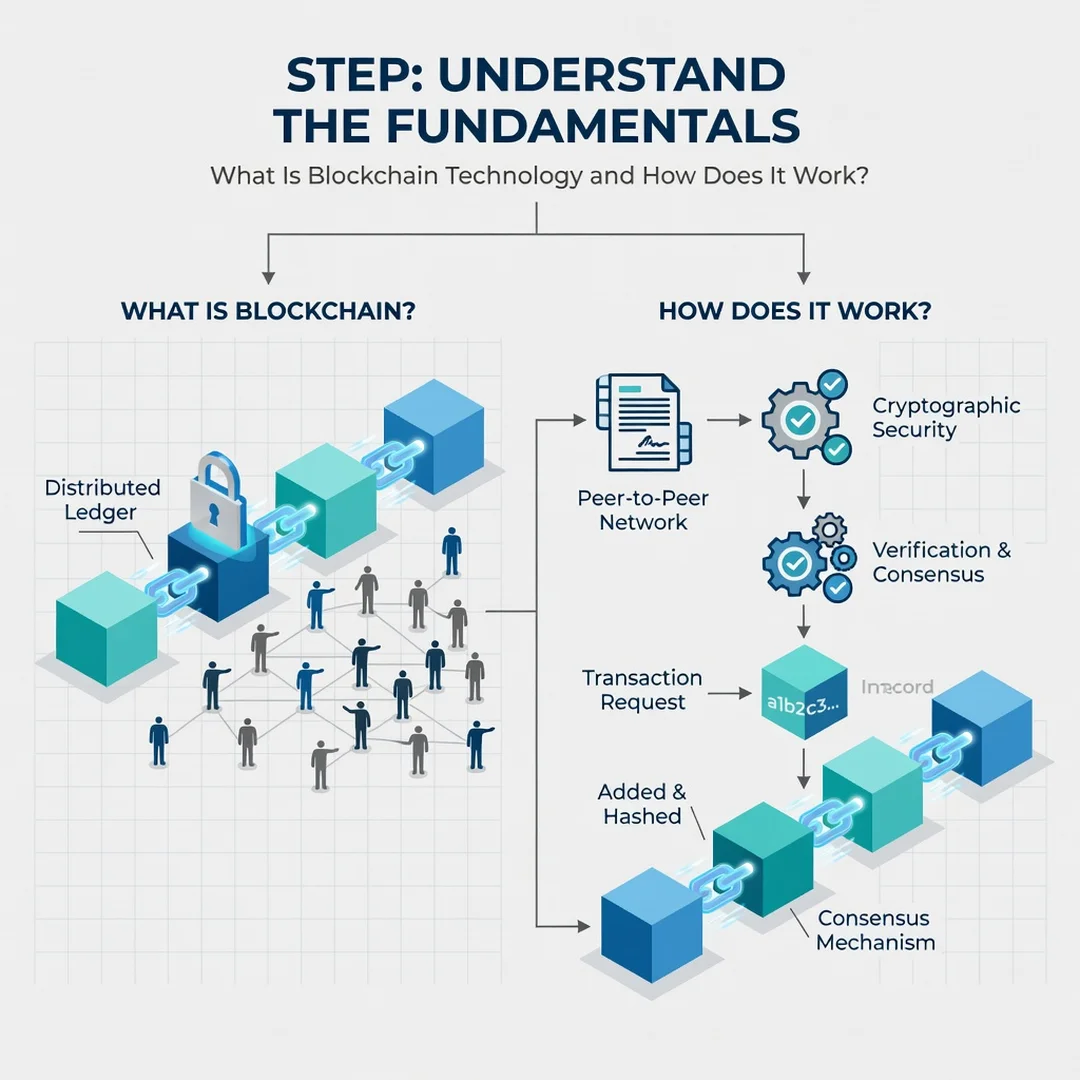
Step 1: Understand the fundamentals
Start with the vocabulary and the basic flow: transactions are broadcast, validated, bundled into blocks, and linked into a chain. Read one or two reputable explainers, then write a short summary in your own words. If you cannot explain it simply, you do not yet understand it well enough to act on it.
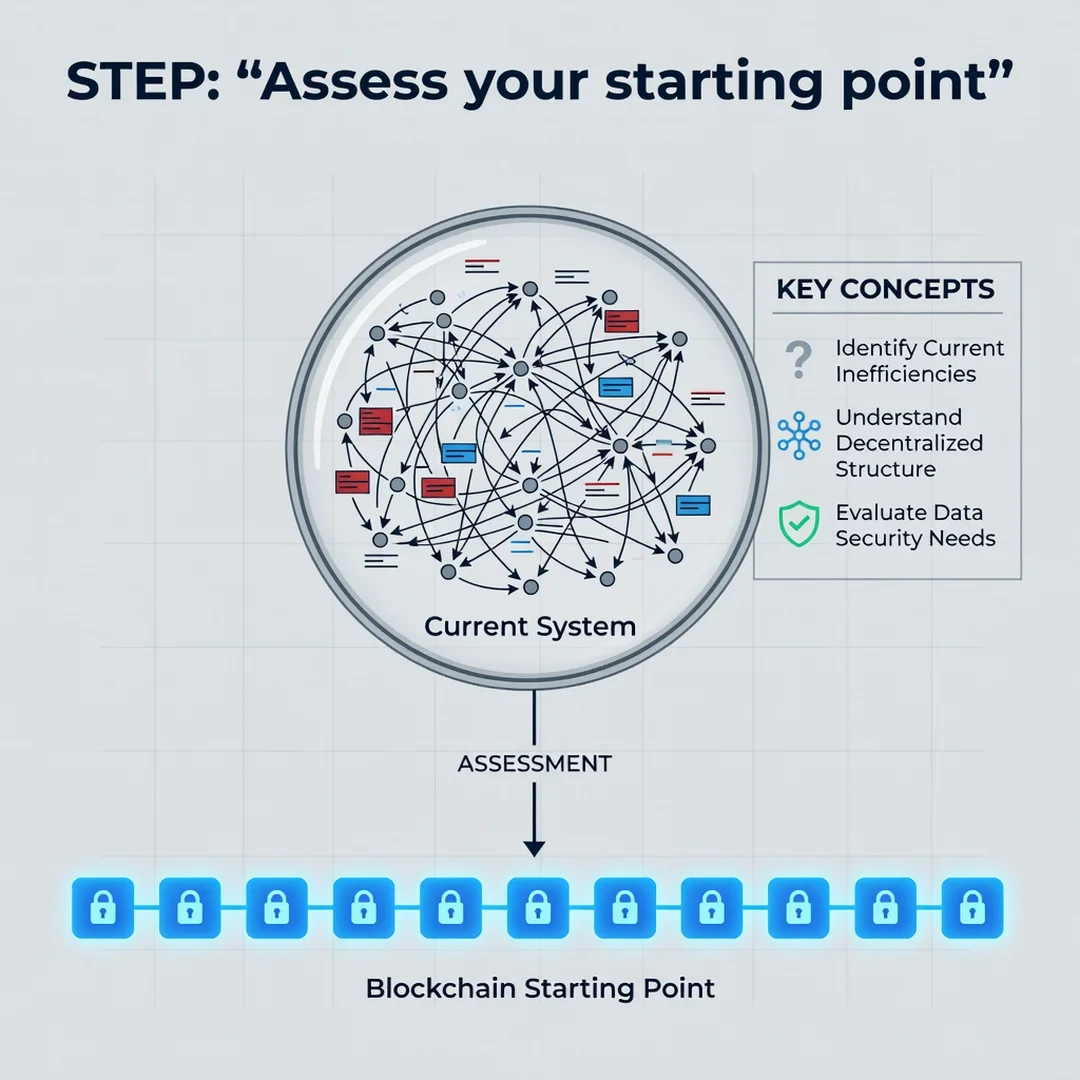
Step 2: Assess your starting point
Be honest about your current knowledge, your goals, and your risk tolerance. Are you curious about the technology, hoping to invest, or evaluating it for a business? Each path demands different depth. Note what you already know and where the gaps are, so your learning stays targeted rather than scattered.

Step 3: Set clear goals
Define what success looks like within a realistic timeframe. A beginner might aim to understand wallets and complete a small test transaction safely. A business evaluator might aim to identify one process where a shared ledger would reduce reconciliation costs. Specific, measurable goals keep you from drifting into endless reading.
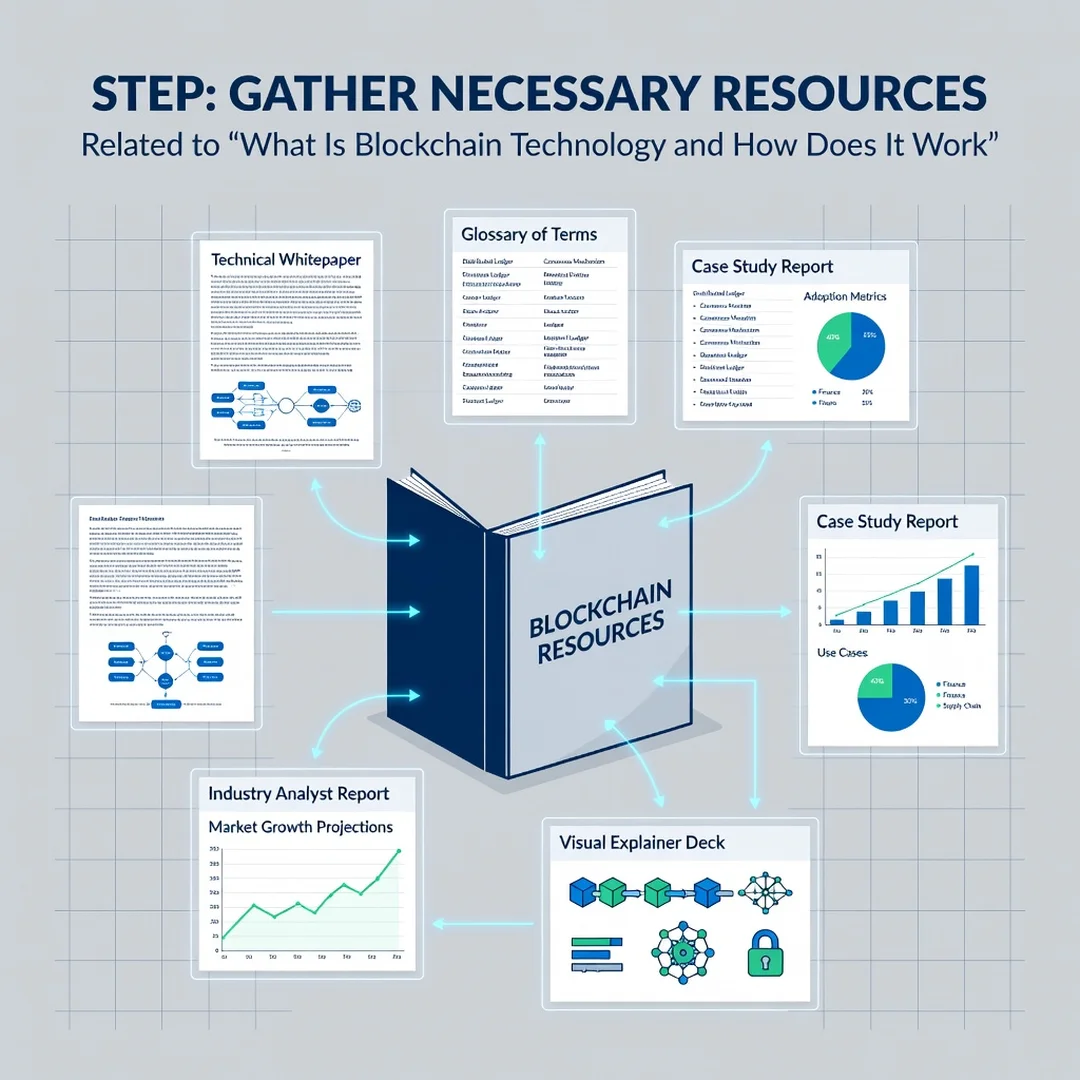
Step 4: Gather necessary resources
Collect trustworthy sources: official documentation, established educational platforms, and communities with strong moderation. Set up a software wallet for practice, use small amounts, and enable every available security feature. Treat your private keys like the deed to your house — because in practical terms, they are.
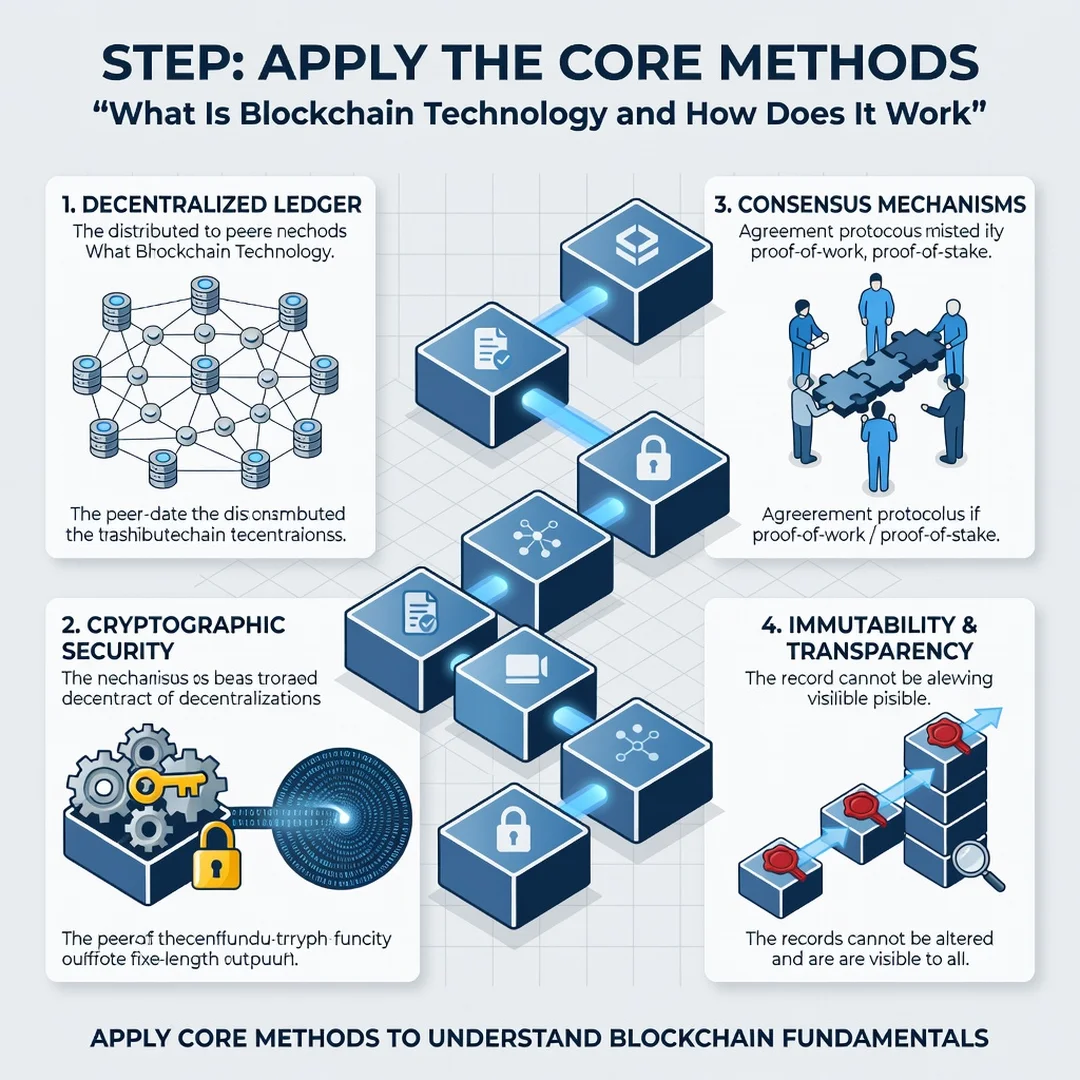
Step 5: Apply the core methods
Put knowledge into practice in low-stakes ways. Send a small transaction and watch it confirm. Inspect a block explorer to see how data is recorded. If you are evaluating business use, map one workflow and sketch how a shared ledger would change it. Consistent, hands-on repetition is what turns abstract concepts into working understanding.
Best Practices
- Verify before you trust. Cross-check claims against multiple independent sources, especially anything involving money.
- Start small. Test with minimal amounts or pilot projects before committing serious resources.
- Secure your keys. Use hardware wallets for meaningful holdings and never share private keys or seed phrases.
- Keep records. Document transactions and decisions; this simplifies taxes, audits, and future learning.
- Stay skeptical of hype. If a project promises guaranteed returns, treat that as a warning sign, not an opportunity.
- Keep learning. The field changes quickly, so revisit your assumptions regularly.
FAQ
What should I know about What Is Blockchain Technology and How Does It Work?
Focus on three essentials: it is a shared, append-only ledger; network participants reach agreement through consensus rules; and its security comes from making tampering economically impractical. Everything else — mining, staking, smart contracts — builds on those three ideas.
Who is this guide for?
It is written for general readers with no technical background who want a clear, practical grounding in blockchain. Beginners, curious professionals, and business decision-makers evaluating the technology will all find the step-by-step framework useful.
Conclusion
Blockchain is best understood as a method for many parties to maintain one trustworthy record without a central authority. Once the vocabulary clicks and you have watched a transaction confirm with your own eyes, the mystery fades and the practical questions take over: where does a shared ledger genuinely help, and where does it add complexity for no gain? By following the five steps, applying the best practices, and keeping your skepticism intact, you will be equipped to answer those questions for yourself — and to make decisions grounded in understanding rather than hype.
Frequently Asked Questions
What should I know about What Is Blockchain Technology and How Does It Work?
This guide covers the essentials of What Is Blockchain Technology and How Does It Work with practical steps you can apply right away.
Who is this guide for?
Anyone looking for a clear, structured overview without unnecessary complexity.
You now have a solid foundation for What Is Blockchain Technology and How Does It Work. Apply the best practices above and revisit this guide as your needs evolve.